Cincinnati, OH · Garage Door Service
Garage door repair for Cincinnati homes built 1938-1999, where original torsion hardware and cold-climate wear cause the same failures across 59 area neighborhoods.
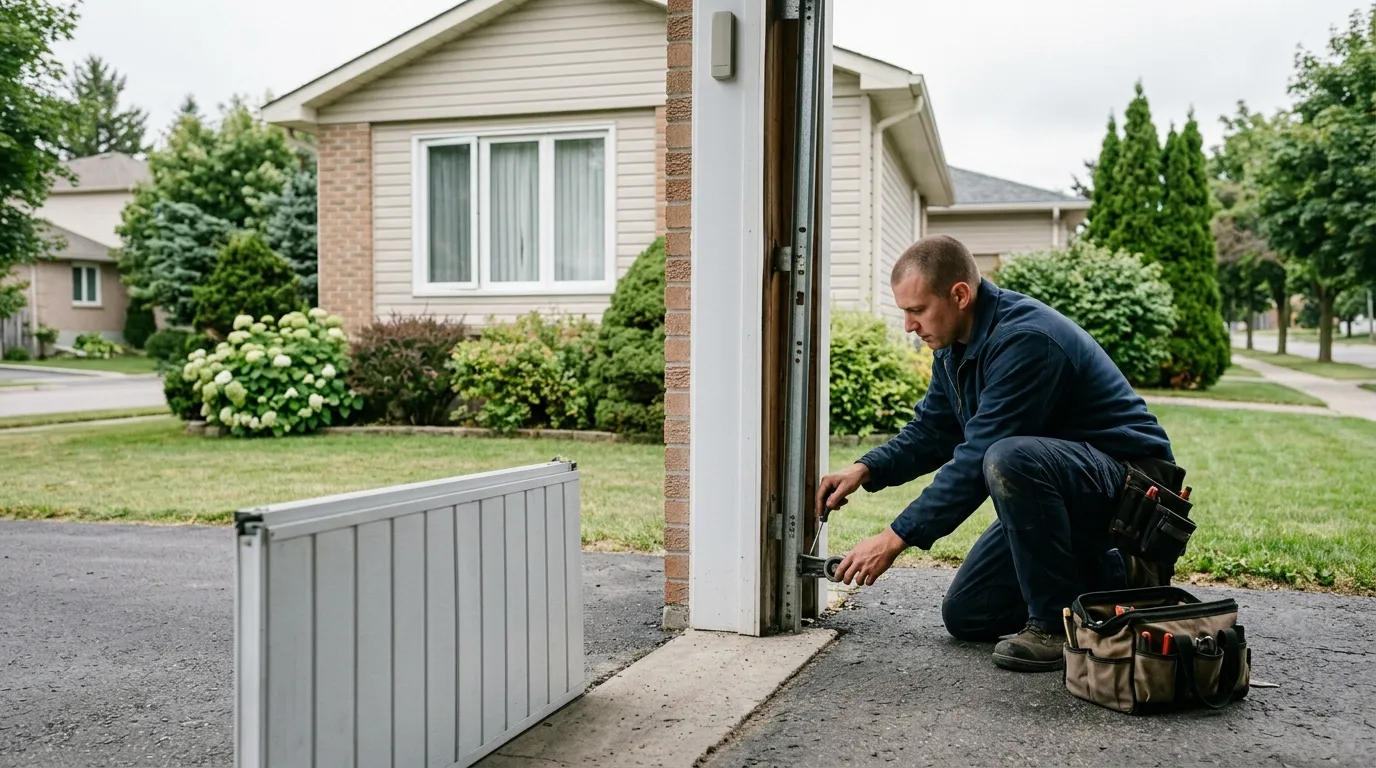
If your door groans, jerks, or stops halfway up, you're not imagining it getting worse. Most Cincinnati garage doors we look at were installed when the house was built, and across this service area that means anywhere from 1938 to 1999, with the median landing around 1972. A door installed under Nixon has had five decades of Ohio winters to work on its springs, cables, and rollers.
The common symptoms: a door that reverses on its own partway down, a spring that's visibly gapped or snapped, an opener that runs but the door doesn't move, or a track that's bent just enough to bind a roller. On older torsion setups - common in the 1960s-70s stock that makes up a large share of housing across the 59 named areas we cover, from Corryville and Avondale in close to Blue Ash and Forest Park further out - the spring is often the first thing to go because it's the one part doing constant work every time the door cycles.
A door that's noisy but still moves smoothly is a different problem than one that's fighting you. Both get worse if left alone, but they don't get worse at the same rate.
Some of this is fair to tackle yourself. Tightening loose hardware, lubricating hinges and rollers, checking that the track is clear of debris - none of that needs a truck. If your door is out of balance or the opener's travel limits are off, those are adjustments most owners can learn.
Springs are where we tell people to stop. A torsion spring under tension holds enough stored force to break a wrist or worse, and on the older, one-piece-door setups still common on houses built before the 1980s across this area, the hardware wasn't designed with today's safety cones or winding bars in mind. We won't talk anyone out of a call for a broken spring - that's not us protecting a job, that's just the honest math on what goes wrong when it goes wrong.
Cables and bottom brackets fall in the same category. If a cable's frayed or a bracket's pulled loose from the door, that's tension and sharp metal in a small space. Panel dents and cosmetic track scuffs, on the other hand, can usually wait and don't need us at all.
The complication isn't usually the repair itself - it's what the repair reveals. A house from the 1972 median build year often has a door and opener that were replaced once, maybe twice, since. That means we're sometimes matching a spring size or a track width to hardware that isn't made the same way anymore, especially on the older side-mounted torsion setups that show up in the pre-1980 stock.
We don't stock every obsolete part on the truck, and on some jobs that means a short wait on a specific spring wire size or a discontinued track bracket rather than a same-day fix. That's the honest limitation: if your door is old enough and unusual enough, the diagnosis is quick but the parts aren't always.
Cold makes the second complication. In a cold-moderate climate like this one, metal contracts, lubricant thickens, and a spring that was already fatigued from age tends to finally let go on the first hard freeze of the season, not gradually. That's why we see a real jump in spring-failure calls once temperatures drop, concentrated in the older neighborhoods where the hardware has had the most winters to wear through.
Two things stack on top of each other across this service area: age and climate. Housing here runs 1938 to 1999 with a median around 1972, so a large share of the roughly 91,321 owner-occupied houses in the area are carrying original or first-replacement garage door hardware that's well past its expected cycle count. A spring rated for a certain number of open-close cycles doesn't care how well it was installed - it counts down the same whether the house is in Hyde Park or Westwood.
The cold-moderate climate band adds the seasonal trigger. Steel contracts in the cold, grease stiffens, and a spring already near the end of its life is more likely to snap on a 20-degree morning than a mild one. Owners across the area, where median household income sits around $79,195, are often deciding between a repair and a full opener or door replacement - and for a door that's outlived its original hardware twice over, replacement is frequently the better math, not just the easier sell.
Cold makes steel more brittle and grease thicker, so a spring that's already fatigued from years of cycling is more likely to finally snap on a cold morning than a mild one. This is common enough across the cold-moderate climate here that we see a real jump in spring calls once temperatures drop.
Not always. Houses built well before 1980 sometimes have torsion hardware or track widths that aren't standard anymore, and on those jobs we may need to order a specific part rather than fix it same-day. We'll tell you upfront if that's the case rather than guess.
Sometimes, especially on a door old enough to be running its original hardware from a 1970s-era build. If the repair is going to be the second or third one on the same aging parts, we'll say so - replacing beats patching once a door's outlived its expected life.
We don't recommend it. A torsion spring holds enough stored tension to cause serious injury, and on older doors the hardware wasn't built with modern safety features. Adjustments like lubrication or tightening loose hardware are fine for an owner to handle - springs and cables are not.
Call now or request a free quote - same-day service on most repairs, upfront written pricing.