Cincinnati, OH · Garage Door Service
Wyoming's housing stock runs older than the Cincinnati average, which means different spring hardware and openers. We travel from Cincinnati for repairs and installs here.
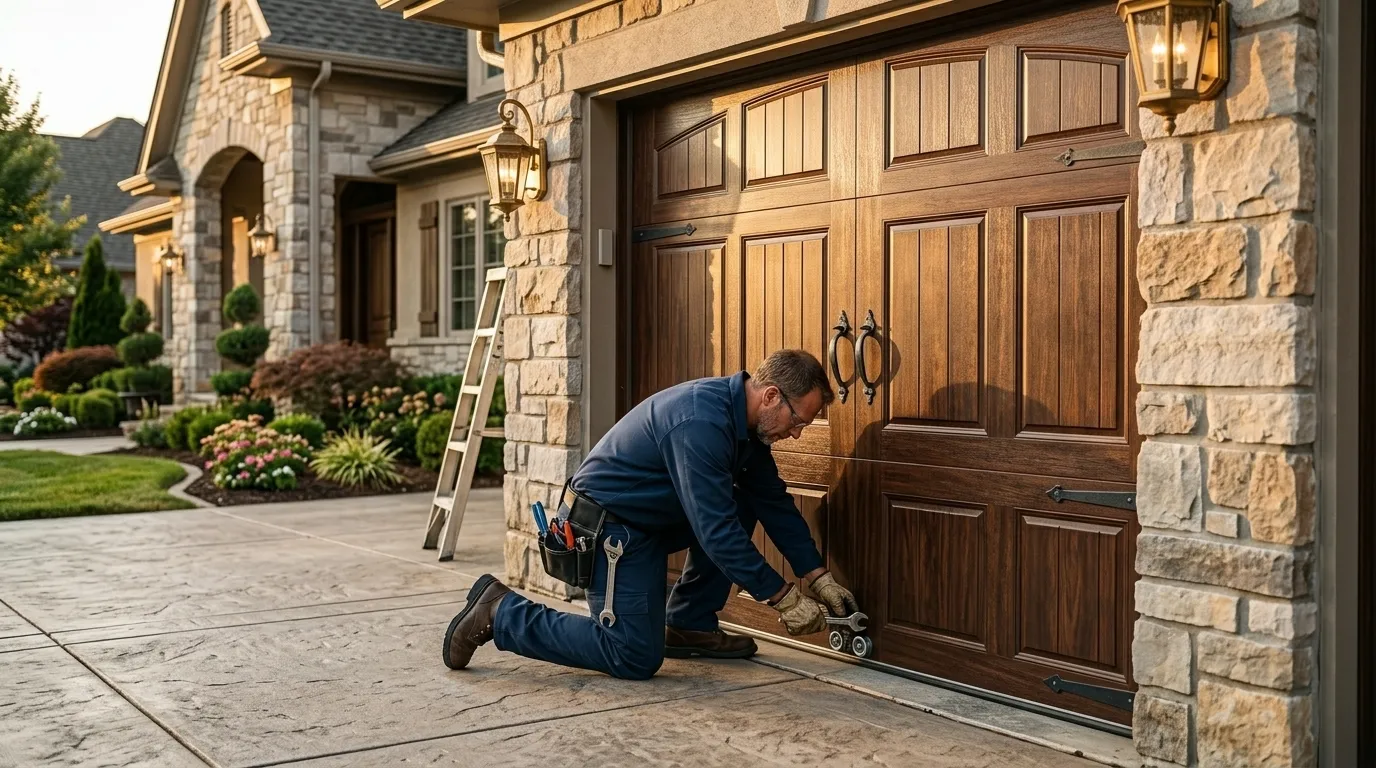
We don't keep a truck stationed in Wyoming. We work out of Cincinnati and drive the 6 miles up when a job is booked, so we can't promise a same-hour arrival the way a shop physically inside the village might. If your door needs a part we don't carry - and on a house built in the early 1950s that happens more than you'd think, since original hardware sizes have drifted over seventy years - we may need a day or two to source it rather than pull it off the truck on the spot.
We also won't tell you to replace a door that just needs a spring and a service call. Plenty of the doors on these older Wyoming lots are structurally sound wood or early steel panels that just need the torsion system brought up to spec. Replacement makes sense when the track is bent past true or the panel section is rotted through, not as a default recommendation. If a repair gets your door running safely for a fair price, that's what we'll quote, even if a full replacement pays better.
Wyoming sits about 6 miles from our Cincinnati base, which is a short drive most of the day. Where timing actually matters is parts, not travel. A garage door built to match a house from 1954 doesn't always take the torsion spring, drum, or track hardware you'll find on a big-box shelf today. If your opener or spring assembly is original or an early replacement, we sometimes need to order the correct size rather than swap in something close.
We'd rather tell you that up front than show up and jury-rig a fix that fails again in six months. When we do have the right part on the truck, the repair itself is usually done in one visit.
The median home in Wyoming was built around 1954, which puts it well ahead of the broader service area's 1938-1999 range and its 1972 median - this is genuinely older stock, not the 1960s-70s tract housing that makes up most of the surrounding 59 named communities. That gap matters for garage doors specifically. Houses from this era were often built with narrower single-car openings or detached garages added later, and the door hardware that went in with them, or shortly after, tends to run smaller torsion springs on side-mounted brackets rather than the center-mounted setups standard on newer builds.
We also work within a cold-moderate climate band here, which means winter temperature swings put extra strain on spring steel and nylon rollers that have already been in service for decades. On a house this age, a spring that's original or a first-generation replacement is usually well past its rated cycle count, and that's often the actual cause of a door that's suddenly noisy or slow, not the opener.
With roughly 3,077 households and a median income near $156,518, Wyoming skews toward larger, better-kept older homes rather than the higher-density housing common closer to the city center. That combination - an older build year and higher household income - tends to mean garage doors that were upgraded once along the way, often with a heavier insulated panel or a quieter opener, but still riding on the original track and header hardware from the 1950s or 60s build.
We see this pattern show up as a mismatch: a newer, heavier door panel bolted onto old brackets and a spring sized for the lighter original. That's not a defect you'd notice day to day, but it does shorten spring life and put more load on the opener's motor than the door was designed for. If your opener seems to be working harder than it should, or the door doesn't quite sit level when it closes, that mismatch is worth a look before you replace anything.
No, we operate out of Cincinnati and drive out to Wyoming, about 6 miles, for scheduled jobs. We don't keep a depot or stage a truck in the village, so we book by appointment rather than promising immediate arrival.
Wyoming's median home dates to around 1954, well before the newer construction common elsewhere in the service area. Older houses here often have side-mounted torsion springs and narrower openings, while newer doors nearby use center-mounted hardware and standard two-car widths.
Usually, but on a house from the 1950s the framing and track brackets may need adjustment to take a modern panel and spring size. We check the opening dimensions and existing hardware before quoting a replacement rather than assuming a standard fit.
Often yes, if the track and brackets are still sound. A worn spring on otherwise good hardware is a straightforward swap. We only recommend full replacement when the panel, track, or frame has failed, not just because the parts are original.
Call now or request a free quote - same-day service on most repairs, upfront written pricing.