Cincinnati, OH · Garage Door Service
Monfort Heights homes date mostly to 1976, meaning specific spring and opener hardware. We travel 6 miles from Cincinnati for repairs, springs, and openers here.
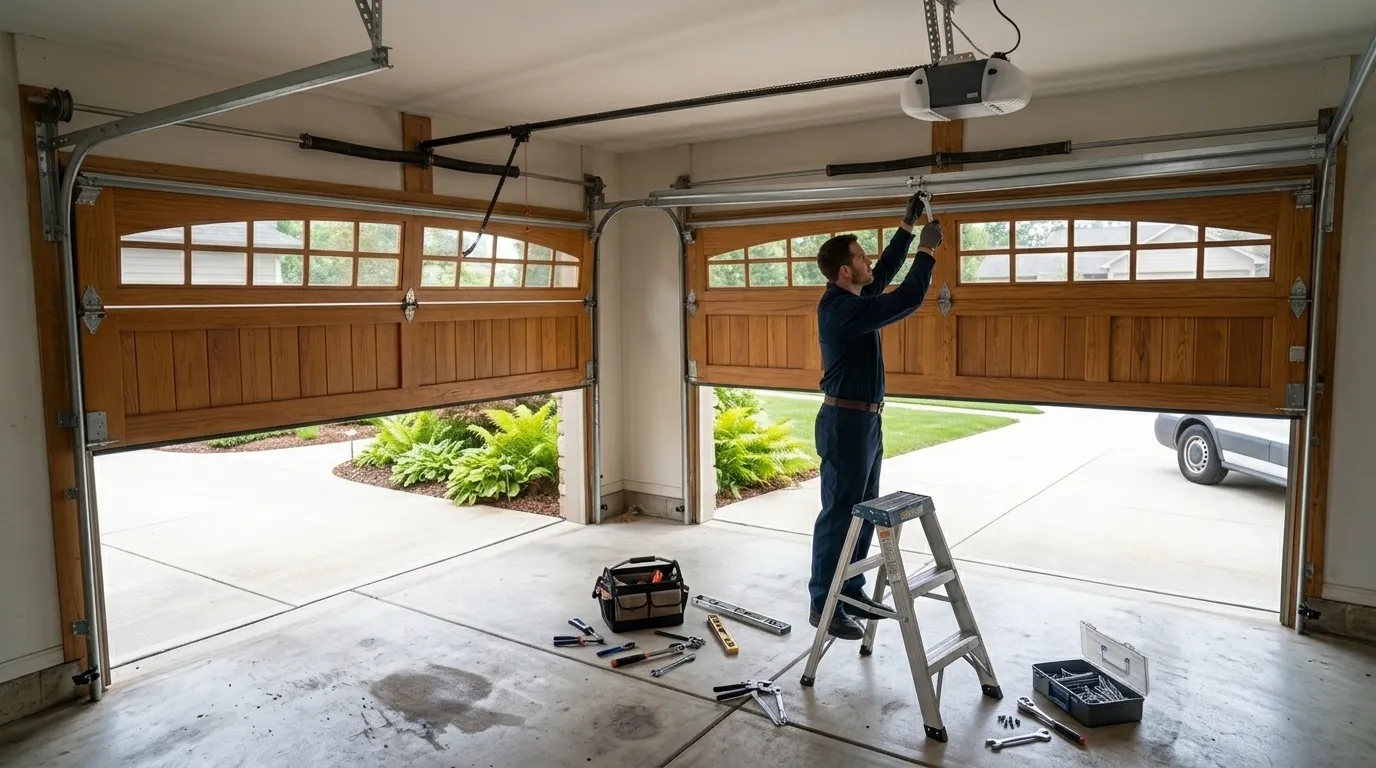
We don't keep a truck stationed in Monfort Heights - we run out of Cincinnati, about 6 miles east, and that shapes what we can promise. We won't tell you we have a same-day crew sitting nearby, because we don't. If your spring lets go at 6am on a weekday, we're honest about the drive time before we quote anything.
We also won't try to repair a door that's cheaper to replace. If your torsion spring is original to a 1976 build and the drums, cables, and bottom brackets are all worn together, patching one part just means another failure in a few months. We'll say so instead of running up a bill piece by piece.
We don't do wood rot repair on doors themselves, and we don't handle openers that are miswired into a home's electrical panel - that's an electrician's job, not ours. If a job needs a part on backorder from the manufacturer, we tell you the wait up front rather than guess at a date to get the sale.
Monfort Heights sits about 6 miles from our base in Cincinnati, inside the same cold-moderate climate band as the rest of the service area. That distance means we build drive time into every estimate rather than promise an arrival window we can't hit from across town.
Winter is where timing matters most here. Cold snaps make old torsion springs brittle, and a spring that's been fine for years can snap on the first hard freeze of the season. Because of the freeze-thaw cycle typical of this climate band, steel track and hardware installed in the 1970s has had roughly five decades of expansion and contraction to work loose fasteners and pit metal - that's a slower failure than a sudden snap, but it shows up as doors that bind or drag rather than glide.
We schedule around that pattern: more spring calls in the first cold stretch of the year, more track and roller calls as the weather flips warm to cold repeatedly in fall and spring.
The median home in Monfort Heights was built around 1976, later than the wider service area's 1972 median but still squarely in the mid-century construction wave that produced these neighborhoods. A door and opener installed when a 1976 house was new is now pushing fifty years old if it's original - most aren't anymore, but the openers that replaced them in the 1990s and early 2000s are themselves due for a look.
That build era means specific hardware: torsion springs sized for the steel doors common in that period, often on a single-spring setup rather than the double-spring systems newer builds use. Extension spring systems, common on garages from this window, need the safety cables that later code required - if yours doesn't have them, that's worth fixing regardless of anything else.
We also see openers here that predate rolling-code remotes, which means anyone with an old universal clicker can theoretically operate the door. Swapping to a modern opener isn't just convenience - it closes that gap.
With roughly 5,133 households in Monfort Heights and a median income of $79,989, this is a settled, owner-occupied kind of neighborhood - not a lot of new construction, not a lot of teardown-and-rebuild. That matters for garage doors because it means most of what we see is repair and upgrade work on doors that have been in place for decades, not first installs.
Across the wider service area, 91,321 of 185,236 households own their home, and Monfort Heights fits that owner-occupied pattern closely. Owners here tend to maintain rather than replace on a whim, which is the right instinct for a garage door - springs, rollers, and cables can be serviced individually long before the whole unit needs to come out.
The practical upshot: if your door is original to a mid-1970s build, don't wait for a full failure. A yearly look at cables, springs, and the bottom seal catches the wear before it becomes a Saturday morning with the car trapped inside.
About 6 miles from our Cincinnati base. We factor that into scheduling rather than promise an arrival time we can't guarantee. For urgent jobs like a snapped spring, we prioritize based on when you call and how the day's route looks.
It's possible but unlikely after this many years. Torsion springs are usually rated for a set number of cycles and most from that era have been replaced at least once. If yours has never been serviced, it's worth a look regardless of how it sounds right now.
Yes - safety cables. If your garage uses extension springs (common in homes from the 1970s) rather than a torsion spring above the door, check for cables running through the springs. Without them, a broken spring can snap free and cause real damage or injury.
Often yes. Older openers usually lack rolling-code security, meaning an old universal remote could open your door. They also tend to lack the safety reversal sensors required in newer units. If yours predates those features, upgrading closes a real gap, not just a convenience one.
Call now or request a free quote - same-day service on most repairs, upfront written pricing.