Cincinnati, OH · Garage Door Service
Cheviot homes mostly date to 1944, decades before the wider service area's 1972 median. That gap changes what breaks on your door and what parts we bring from Cincinnati.
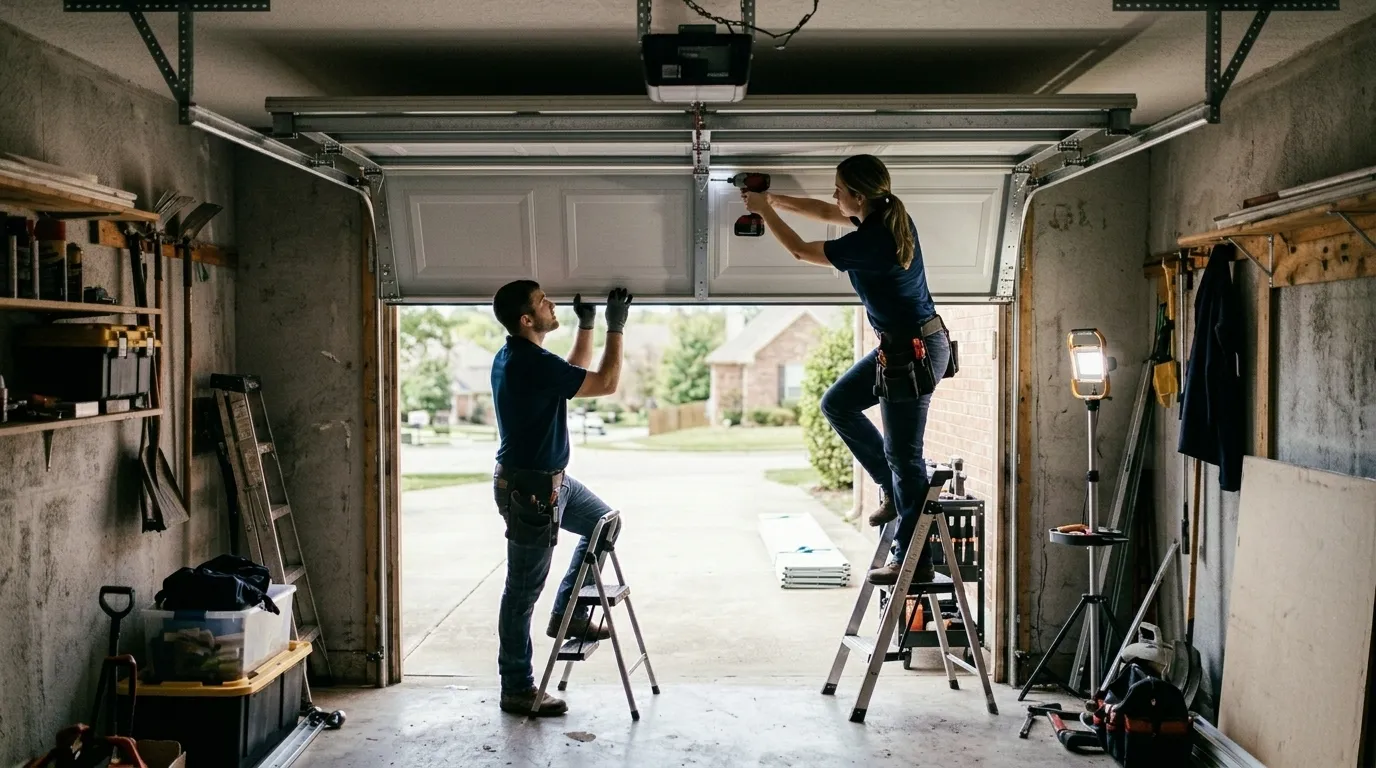
We don't stock every obsolete part on the truck, and Cheviot's housing stock means we run into obsolete parts more than most of the areas we cover. A door built for a house from 1944 may have hardware nobody manufactures anymore - track brackets, drum sizes, even panel dimensions that don't match anything on a current supplier's shelf. When we hit one of those, we tell you straight rather than jury-rig a fix that won't hold. Sometimes the honest answer is a full replacement unit sized to fit the existing opening, because sourcing an exact period match costs more than the door is worth. We also won't quote a job sight unseen over the phone when a house this old is involved - too much hides behind old trim and settled framing. We're traveling in from Cincinnati, not sitting in a Cheviot depot, so we schedule the visit, look at what's actually there, and go from that. If the fix is quick, we say so. If it isn't, we say that too.
Cheviot sits about 6 miles from Cincinnati, close enough that travel time isn't the bottleneck on most calls. What slows a job down here is parts, not distance. A spring or opener failure on a house built in the 1970s or later usually means a same-day fix with common stock. A house from the 1940s, which describes a large share of Cheviot, sometimes means a return trip once we've confirmed exact measurements and ordered the right track or drum. We'd rather tell you that up front than promise a one-visit fix and miss it. Cold-weather season adds its own wrinkle: springs and rollers on older hardware tighten up and fail more often when temperatures drop, so late fall and winter calls in this area tend to run heavier than summer ones.
The median home in Cheviot went up around 1944, well ahead of the 1972 median across the wider service area we cover from Cincinnati. That 28-year gap is not trivia - it's the difference between a door built for modern extension springs and one still running on hardware from a very different era. Houses from the 1940s were often built with narrower garage openings, single-panel doors, or tracks mounted for spring configurations that later became rare. If your door has never been replaced, the torsion or extension spring on it may be an older style that a supplier has to special-order rather than pull off the shelf. We see this pattern often enough in Cheviot that we plan for it: bringing more than one bracket size, expecting to measure twice, and not assuming the fix that worked on a newer house down the road will fit here.
Cheviot has about 3,581 households, most in homes built well before the postwar boom that shaped much of the rest of the region covered from Cincinnati. Median household income here runs $54,654, noticeably below the roughly $79,195 median across the full service area - a gap that matters when we're talking replacement versus repair. On an older door with obsolete hardware, a full swap sometimes costs less in the long run than chasing down discontinued parts piece by piece, and we say that plainly rather than padding a repair bill. The region sits in a cold-moderate climate band, and on houses this age the weatherstripping and seals are often original or close to it, which means more air movement through the door than a newer install would allow. None of that is a defect specific to any one house - it's just what happens to garage doors over eighty years without an upgrade.
Houses built around 1944, common in Cheviot, often have narrower openings and older spring or track configurations than homes built decades later. A part that fits a 1970s door frequently won't fit a 1940s one, so we plan for a possible second visit if measurements don't match standard stock.
No. We travel to Cheviot from Cincinnati, about 6 miles away. That doesn't slow down most repairs, but it does mean we schedule a visit to assess the door rather than quote blind over the phone, especially on older houses.
It depends on what's wrong. If the hardware on an older door is obsolete, sourcing exact-match parts can cost more than a new unit sized to the same opening. We'll tell you honestly which way the math points once we've seen the door.
Yes. In this cold-moderate climate, springs and rollers on older hardware tend to stiffen and fail more in late fall and winter. Original weatherstripping on houses this age also lets more cold air through than a modern seal would.
Call now or request a free quote - same-day service on most repairs, upfront written pricing.